• MOTION PICTURE
    • Documentaries
    • Feature Films
    • Short Films
    • Commercial
    • Television
    • Behind the Scenes
  • EARTH IN PHOTO
  • WILDLIFE PHOTOS
  • HUMAN PHOTOS
  • Bio
  • Blog
  • Contact & Booking
  • Menu

Ben Blankenship

  • MOTION PICTURE
    • Documentaries
    • Feature Films
    • Short Films
    • Commercial
    • Television
    • Behind the Scenes
  • EARTH IN PHOTO
  • WILDLIFE PHOTOS
  • HUMAN PHOTOS
  • Bio
  • Blog
  • Contact & Booking
VistaPano1.jpg

Hunting for Gold in Ringworm River

April 11, 2018

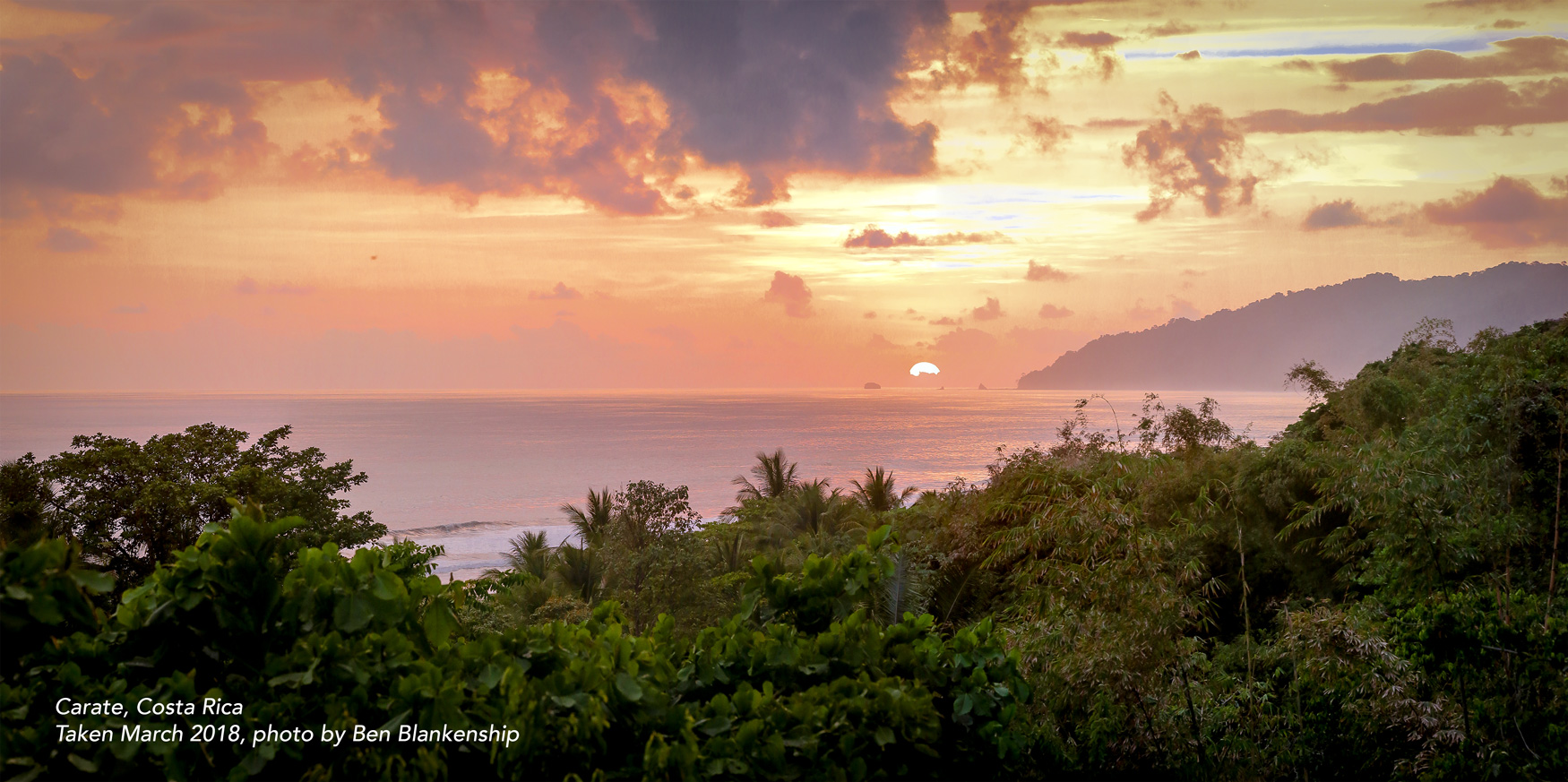
To start things out, I think an explanation of just where in the hell I am would be appropriate.  I am living in the far southwest corner of Costa Rica, on a piece of geography known as the Osa Peninsula. This region of Costa Rica contains the largest pristine rainforest in Central America.  And sprinkled amongst this massive forest are several small villages, connected by dirt roads or even just footpaths in some cases. It is one of these small communities that I call home, the village of Carate (pronounced kah-RAH-tay).  This small community consists of four off-the-grid ecolodges, a few vacation homes, and the sporadically spaced homes of locals.  I would estimate that the year-round population of Carate is less than 75 people.  It is quite literally the village at the end of the road, a road which also happens to be the longest dirt road in Costa Rica.   The dusty jungle path starts in the town of Puerto Jimenez before it begins climbing thick canopied hillsides. After 40 kilometers, it weaves its way back down to sea level and then along the longest stretch of unspoiled beach I’ve ever seen.  This is Carate Beach.  The road continues parallel to the beach until coming to its end at a remote airstrip that sits on the banks of Rio Carate.  One can cross this river by foot, and then walk a two-mile trail through the forest before arriving at the entrance of Corcovado National Park.  

Surprisingly, there is public transit from Puerto Jimenez all the way out to Carate, but not in the sense that those of us from more developed countries might imagine.  The preferred means of travel to Carate is via the colectivo.  This operation is a small family run business that uses converted box trucks to shuttle people along this 50km road.  The back of the truck has a wooden floor, wooden railing around the sides, and a metal scaffold covered in their trademark blue tarp for a canopy.  A bench lines each side railing, covered in handmade blue cushioning that does little to absorb the jarring vibrations felt as the truck bounces up and down the busted dirt road.  The ride from Jimenez to Carate costs about $8.00 US.  The experience is tough.  With the intense bouncing comes waves of exhaust filling the passenger area as the driver downshifts to make it up the steep inclines. The clatter of the truck with its makeshift implements is near deafening.  Dust is everywhere, coating everything.  And, for those of us born with testicles the colectivo can be particularly painful, as genitals are pounded by the hard benches if not sitting in just the right position.  The smartest travelers on the colectivo use bandanas or buffs to cover noses and mouths, sunglasses to protect the eyes, and loud music playing in ear buds to help muffle out the ear-splitting racket as the truck smashes down the rocky path.  

Recently, I’ve been reading up on the history of the Osa Peninsula, and also speaking with locals about the region’s past.  I’ve learned that in the 1930’s, before Costa Rica had national parks, or any conservation-based policies at all for that matter, the area that is now called Corcovado was the site of a major gold rush.  Huge deposits of exceptionally high-quality gold were being pulled from rivers .  But the mining efforts had a devastating effect on local wildlife.  And in 1975, President Daniel Oduber declared the area protected, dubbing it Corcovado National Park.  

Artisanal gold miners still work the rivers, such as Rio Carate, just outside  the park, and many still work covertly within the park to access forgotten gold deposits.  These miners  risk being imprisoned for such violations.  But, most ‘gold hunters,’ as they refer to themselves, still work the areas just outside the park, especially Rio Carate.  Make-shift camps line the river’s banks made from crude bamboo frames and covered with black plastic tarps.  Miners live and work from these camps throughout the year.  Children here learn how to pan and dig for gold from an early age and spend much of their life laboring in the shallow silty waters of Rio Carate.  One such individual has become a good friend.  He speaks some English, and with my limited Spanish, he and I can usually manage a decent conversation.  We will call him Eduardo, not his real name, because he is one of these gold miners who often ventures deep into the mountains of Corcovado National Park on the hunt for bigger earnings than what can now be found in Rio Carate.  I’ve asked him already if he would ever take me with him on such a mission, so I can see firsthand what life is really like for gold hunters such as him.  He lives on meager earnings and supplements his food resources by hunting illegally for agouti and paca (giant rodents), which he does with the help of his dog.  This was, and still is, a common practice for miners living in the jungle, to use poaching as a means of sustaining themselves while on a dig.  It was also supposedly one of the primary reasons that the National Parks were set up back in 1975, to protect the animals that were being hunted for food by miners in the area.

Two nights ago, after I’d gotten off work, Eduardo and I sat up for several hours drinking rum chased with cola, talking fishing, hunting, hiding from the park police, and just what we would do if we hit the mother lode.  I asked him if gold could still be found in Rio Carate, to which he shrugged, and said, “Sure…some.  But, if tourists found out what Carate means, they wouldn’t want to come here.”  I, of course, asked, “well what does it mean?”  His story, paraphrased, went like this: When miners were expelled from Corcovado, they began looking for gold in the surrounding rivers. Gold was subsequently found in Rio Carate.  But when miners began working the river in earnest, many of them broke out with ringworm, a skin fungus that appears as concentric circles all over the skin. He explained that in Costa Rica, the word Carate means ‘ringworm.’ So, the gold miners named Rio Carate for the fungus that afflicted so many of them. And the town of Carate was named for the river that runs through it.  So, I live in the town of Ringworm on the banks of the Ringworm River.
Tags: costa, rica, central, america, gold, oro, corcovado, national, park, wildlife, photography, photojournalism, travel, living, costa rica, poachers, miners, poaching, paca, agouti
Prev / Next

ARTICLES

Featured
 VIDEO! The Iceland Volcano - Fagradalsfjall
September 28, 2021
VIDEO! The Iceland Volcano - Fagradalsfjall
September 28, 2021
Read more →
September 28, 2021
_I6A3802.jpg
December 23, 2020
Merry Christmas - A Call-out - And Some Pretty Pictures
December 23, 2020
Read more →
December 23, 2020
The Return of the Colorado Gray Wolf
November 12, 2020
The Return of the Colorado Gray Wolf
November 12, 2020

On November 3rd, 2020, one of the most historic elections in United States history took place, with the highest voter turnout in the history of the country. But, in Colorado, another piece of historic legislation was passed. Winning by a slim margin, Colorado Proposition 114, the Gray Wolf Reintroduction Initiative, was passed. This represented the first time ever that a state used the ballot box to decide whether to reintroduce an extirpated species. Proponents of the bill pointed to the success of the wolf reintroduction programs in Washington, Idaho, and most famously, in Yellowstone National Park as evidence of the benefits for reintroducing the apex predator to their historic range. Opponents call it biology by ballot box, and insist that the potential economic damages created by wolves outweigh the ecological benefits of their reintroduction.

Read more →
November 12, 2020
Big Announcements and Dreams of Travel - Print Sales Open!
August 3, 2020
Big Announcements and Dreams of Travel - Print Sales Open!
August 3, 2020

As the global travel market remains at a standstill amidst the seemingly unending spread of COVID-19, many of us remain at home, dreaming of exotic destinations and a break from the monotony. And though it will largely remain up to the individual as to when it feels appropriate to begin traveling again, this may be the perfect time to surround yourself with natural beauty in another way, by adorning your home or business with images of wildlife and wild places taken from the world.

Since March of this year 2020, my work guiding and traveling has ground to a halt. Like many others in the travel and guiding industries, I feel like a refugee in my own country, unable to return to my Costa Rican home due to travel bans. A time of forced rebuilding has been thrust upon me and many others during a time of great uncertainty. But, one cannot wait forever, and with that in mind, I am putting one step forward at a time, anticipating that the big break will come eventually.

Read more →
August 3, 2020
A Photo Guide Life
January 5, 2020
A Photo Guide Life
January 5, 2020

Hello and happy new year to all my readers, and apologies for a long absence! I’ve been working over the past year as a photography guide and instructor, in addition to my freelance work. This has proven to be a real joy for me, and I wanted to share with you just what it’s like to experience Costa Rica through the eyes of a photography guide making a living down here, as well as share some new photographs from my journeys. I hope to continue to share these experiences with you. So, should you enjoy it, drop me a line or leave a comment so I know! Thanks and Enjoy!

Read more →
January 5, 2020
1I6A4667.jpg
March 13, 2019
Chainsaws in Paradise - Plus New Photos
March 13, 2019

In everything there must be balance. And living in a developing country reminds me of that regularly. I love when people call Costa Rica paradise. Sure, in the photos, the tropical beaches and mountainous jungles look like heaven. But, you can’t see the heat in the photos. You can’t see the mosquitoes, and you certainly can’t see the regular frustrations that come with living in a developing country. Like today for instance, one of the hottest days of the year, in a year that has been the hottest since 2014 on the Osa, some idiots with a chainsaw took it upon themselves to take down a tree that was growing alongside the road just a stone’s throw from my house. They didn’t cut a wedge out of the trunk to control its fall, nor did they tamp a metal wedge into the cut to push the tree’s fall away from the power lines. Instead, they cut the trunk straight across, and you guessed it; the tree fell directly onto the power lines.

Read more →
March 13, 2019
Return to the Osa (With a New Job, New Documentary, and New Photos)
February 1, 2019
Return to the Osa (With a New Job, New Documentary, and New Photos)
February 1, 2019

With 2019 fully under way, I am returning to my blog to update everyone on what has been happening in my life. The last post I made was about arriving in Uganda for my assignment with Photographers Without Borders (PWB). Though that experience deserves a post in itself, and will hopefully receive one, for now I am content with saying that it was eye-opening, challenging, and absolutely an incredible experience. I will write a full description of my time there, as well as my experience with PWB soon, assuming my life remains somewhat calm for the foreseeable future.

Read more →
February 1, 2019
From Costa Rican Paradise to Ugandan Village Life
July 21, 2018
From Costa Rican Paradise to Ugandan Village Life
July 21, 2018

It didn’t become real until I walked outside the Dubai International Airport for the first time. I was hit with an oppressive combination of heat and humidity, the first tangible sensation I’d yet felt that told me that I was far from home. For the first time, I was in the middle east, and one day from flying into Entebbe, Uganda.

Read more →
July 21, 2018
A Wedding in Paradise - Osa Peninsula Style
June 26, 2018
A Wedding in Paradise - Osa Peninsula Style
June 26, 2018

I love a good wedding. It seems to me, with the proliferation of social media and technology, opportunities for true candor, face to face, between people are becoming more and more rare. That is why weddings can be such a special moment for all those in attendance. They provide that rare opportunity for people to truly express how they feel for one another. And not just for those getting married. Loved ones expressing their appreciation and love for the bride and groom (or bride and bride, or groom and groom) seem to experience a level of truth seldom, if ever, felt in day to day life. And this was something I witnessed take place a few days ago on an isolated black-sand beach on the Osa Peninsula.

Read more →
June 26, 2018
Costa Rican Castration Party - Part One // WARNING, GRAPHIC
May 9, 2018
Costa Rican Castration Party - Part One // WARNING, GRAPHIC
May 9, 2018

Located along the road from Puerto Jimenez to Carate is the sprawling Finca Bijagual (pronounced Bee-Ha-Gwahl). Both a tourist destination, offering guest cabins, a restaurant, and horseback riding, Bijagual is also a functioning cattle farm. Bijagual is owned by the always pleasant Don Trino. A towering and elderly Tico, he is bespectacled and always clad in a Hawaiian style button down. Instead of floral patterns, his shirts feature images of cowboys roping steers, fisherman battling marlin, or scenes of Daffy Duck and Goofy sipping cocktails on a beach. He can always be found hanging in the restaurant, an open-air pavilion located just adjacent to the road. The Bijagual restaurant also serves as a venue for the occasional dance party, events that draw attendees from all the nearby villages. Beer and cacique guarro (Costa Rican-made sugar cane liquor) flow freely while partiers couple up to dance the merengue, salsa, and bachata. These events go late into the night, and almost always go on without incident. The same, however, cannot be said for one Bijagual party that occurs but once a year. Coinciding with the birthday of Don Trino’s son, this event is the annual castrating of the bulls.

Read more →
May 9, 2018